
V – How to Verein
With the video series ABC of Urban Practice, we bring together useful practical knowledge for city makers.
Want to shape your city together with others? An association could be the right structure for you. It offers legal security, eligibility for funding, democratic decision-making processes, and long-term stability—perfect for urban projects that want to have an impact beyond short-term actions.
Video
Here you can find our explanatory video with Elisabeth Knoblich (Association for Erotic Education) and Rebecca Wall (Urban Practice).
Why an association?
Legal structure: Members are protected from personal liability; the association can rent premises, enter into contracts, and employ staff.
Eligibility for funding & donations: Non-profit organizations can apply for funding and issue donation receipts—important resources for urban projects.
Democratic processes & continuity: Committees such as the Executive Board and the General Assembly ensure transparency and long-term stability.
Symbolic legitimacy: A “registered association” appears reputable and facilitates cooperation with authorities or institutions.
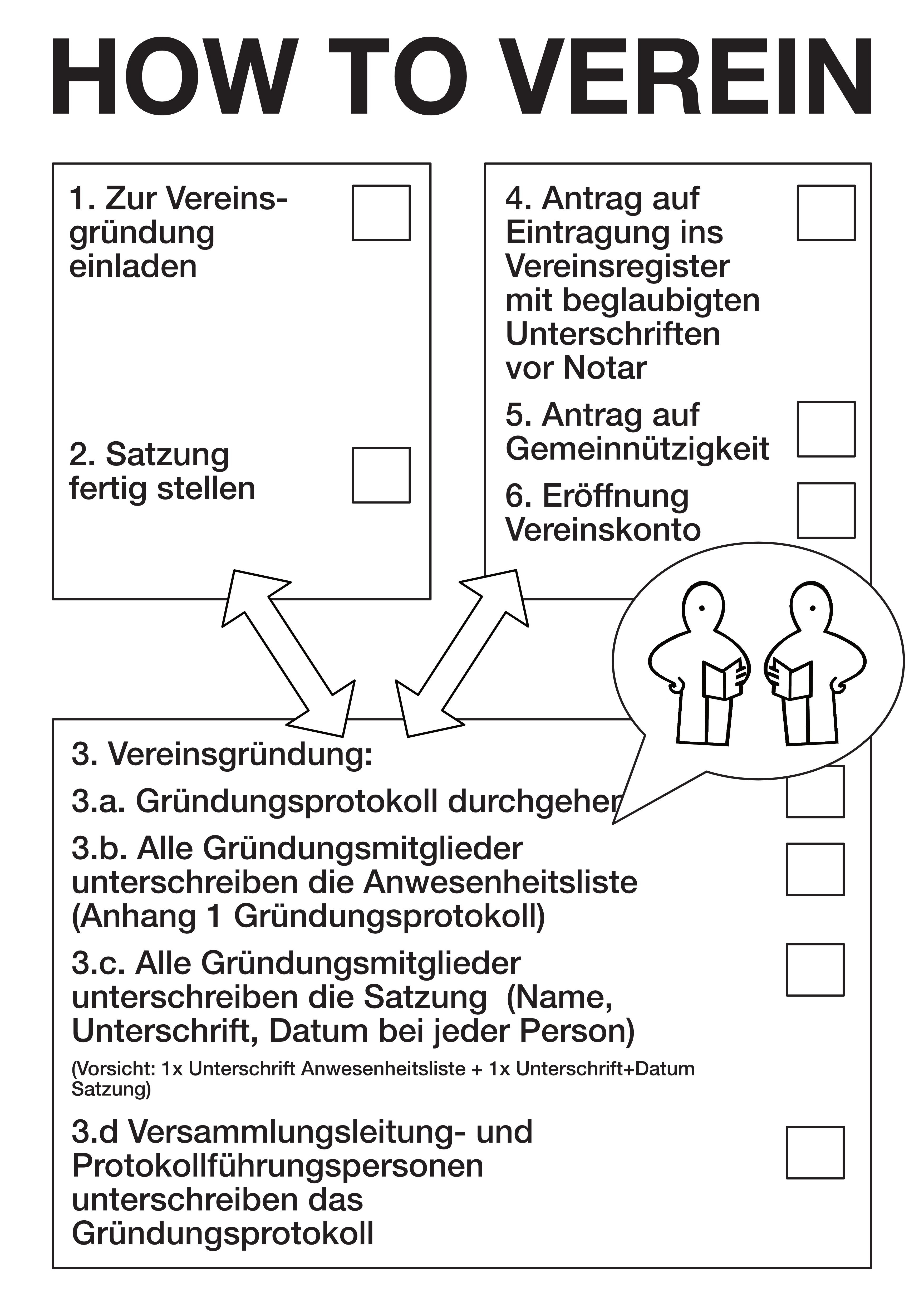
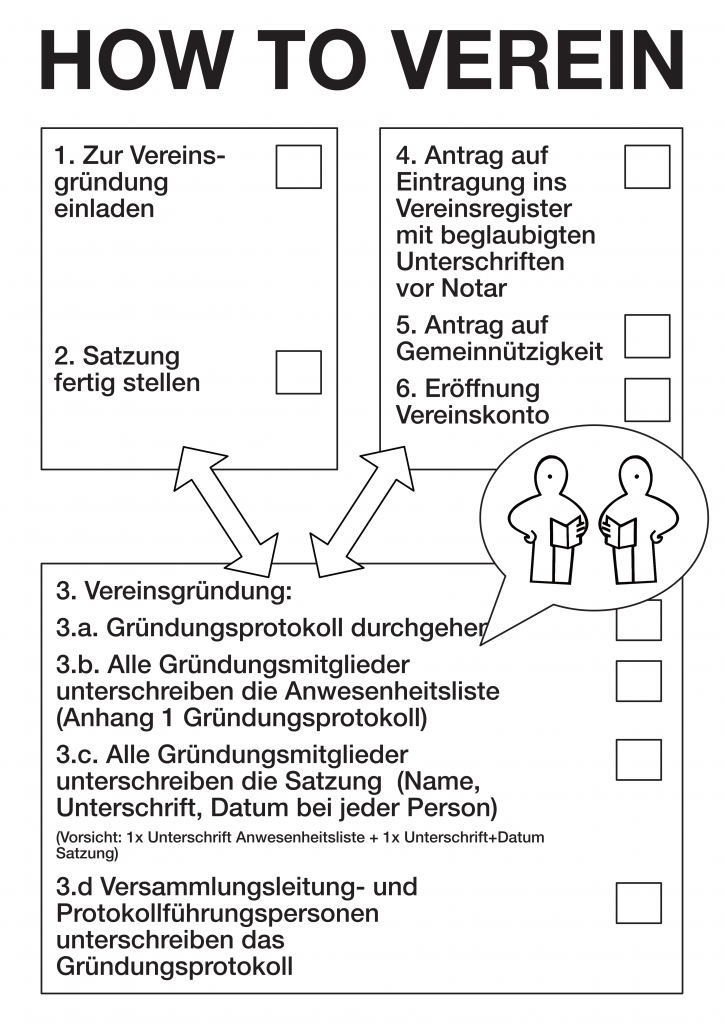
Step by step guide to founding an association
Alternatives to the association
Not every initiative needs an association:
GbR: Quick and uncomplicated, but no non-profit status, personal liability.
Loose initiative group: Flexible, no bureaucracy, but no legal status or eligibility for funding.
Cooperative sponsor: “Sharing” non-profit status, dependent on external sponsor.
Cooperative: Democratic, economic focus, but complex to establish.
Questions about the cooperative for Team Dis+Ko eG
Why an eG at all?
We spent a long time looking for a legal form that would come as close as possible
to a collectively managed business. For us, it was particularly important
that there be no or extremely flat hierarchies and that
our entrepreneurial work function independently of individuals. The
cooperative belongs to all active members and is legally represented by an
elected board of directors, which changes over time
and can also be voted out of office. Other corporations
do not provide for democratic levers and processes for this purpose.
Would you have been unable to implement certain projects without this structure?
We worked together for a long time in a legally unregulated form and
carried out freelance projects. However, especially when collaborating with and
being commissioned by public clients, it is important to have a
registered company form. For us personally, this also has
something to do with the liability risk, which we want to keep as low as possible for the team members.
That’s why we deliberately wanted to transfer this to a
company and not to us as private individuals.
How have you organized democratic decision-making processes in your cooperative?
Does it work well?
We make our decisions based on the principle of consensus. Democratic
processes are relatively time-consuming, and at some point we also had to
realize that we cannot discuss everything in the entire group.
We are now organized into smaller project groups that can make decisions independently within
the project. When it comes to overarching issues that
affect the entire group, everyone is of course brought back together
and we discuss decisions together.
Step by step towards becoming a cooperative
How long did the entire process take, from the initial idea to where you are now?
Our founding process has been with us almost since the beginning of our
joint work. It really took shape in the last two years, when
some of us could imagine working in the collective as our main activity.
At the same time, we had our first orders from public
clients in prospect, for which we then had to take out insurance
for the first time and which also involved a certain
liability risk for the first time.
Why didn’t you opt for a different organizational form or a loose
association?
The appeal of the cooperative is that we don’t have to operate as self-employed individuals with
individual risks, but that we can employ ourselves as normal
employees in our cooperative. This also takes away
some of the pressure that you might otherwise feel as a self-employed person. Ultimately,
we are of course something in between. A loose association would have meant
that the group identity might have been lost.
In your opinion, what structure is best suited to a project and when?
For us, it currently works best when two to a maximum of three people
work on a project. You can divide the tasks well and don’t
feel like you’re taking on the responsibility alone. It also makes
decision-making processes more efficient.
What advice would you give to other groups considering setting up an eG?
Exchange ideas with other eG’s working in a similar context. That’s what
we did. One of the reasons why it took us
relatively long to set up our company is that we contacted other
offices, collectives, and groups and asked them about their organizational structure.
Anything other than a GmbH (limited liability company) is strangely underrepresented in
the general discourse. For a long time, we were unclear about the possible
options, especially because cooperatives for engineering services
are not yet well established. We exchanged ideas with some who operate the same
model and were always received very warmly.
It also helped a lot to use other eGs as a guide for the articles of association, for example.
You should familiarize yourself with the advantages and disadvantages of the business form You should familiarize yourselves with the advantages and disadvantages of this business form
and also with the obligations associated with an eG.
But, to be honest, it is also a very complex form
of incorporation—in terms of both capacity and finances. Investments that are worth the
jointly organized legal form and structure to us, but also not
insignificant.
Whether it’s an association, a loose association, or a cooperative—the key thing is that your structure suits you. Test, experiment, and network!
If you have any questions, feel free to contact us at: office@urbanepraxis.berlin
Extras & Resources:
Downloadable templates:
Video: Raquel Gomez Delgado
Animation: Korbinian Fischer, Dana Schneider
Interview: Rebecca Wall, Elisabeth Knoblich
Postproduction: Dana Schneider