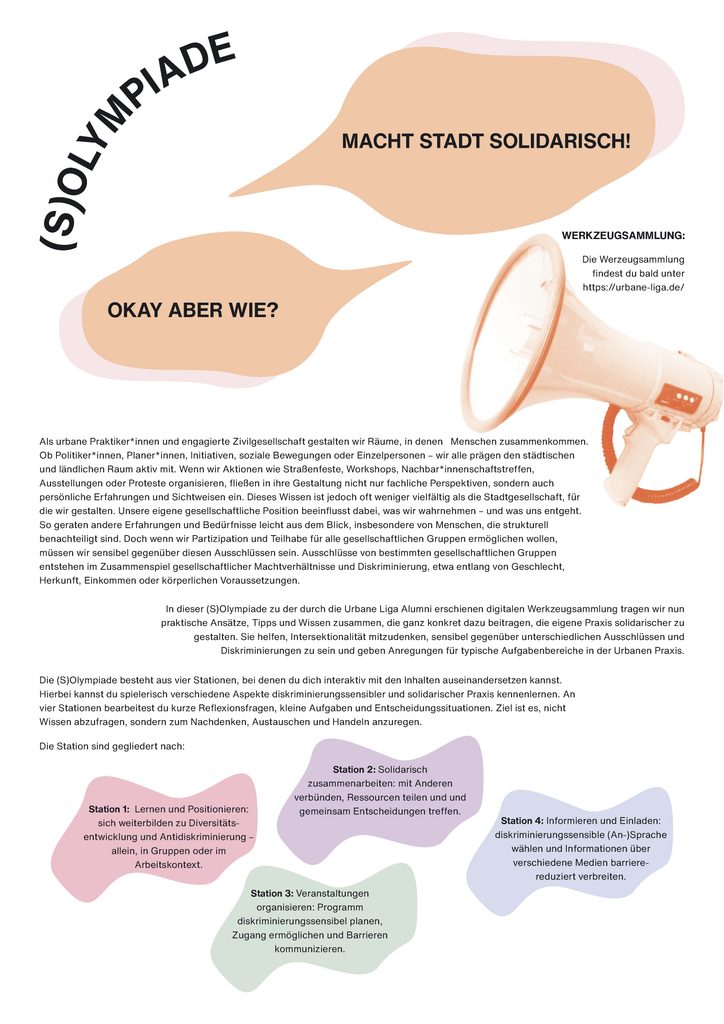
Toolbox Game for “(S)olympiade: Bringing the City Together in Solidarity—Okay, but How?!”
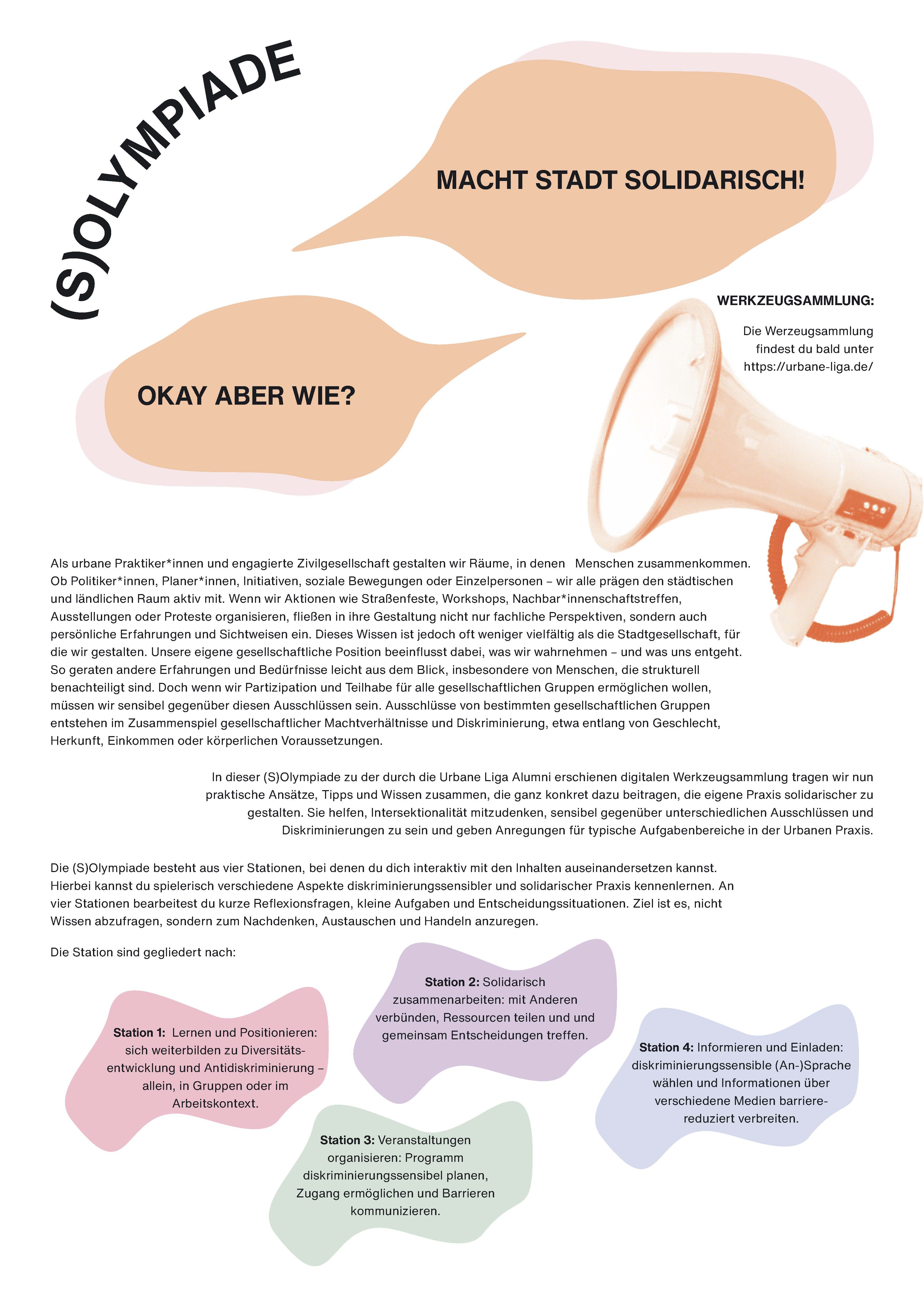
As urban practitioners and active members of civil society, we shape spaces where people come together. Whether we are politicians,
As urban practitioners and active members of civil society, we shape spaces where people come together. Whether we are politicians, planners, grassroots initiatives, social movements, or individuals—we all play an active role in shaping urban and rural spaces. When we organize events such as street festivals, workshops, neighborhood meetings, exhibitions, or protests, their design incorporates not only professional perspectives but also personal experiences and viewpoints. However, this knowledge is often less diverse than the urban society for which we design. Our own social position influences what we perceive—and what we overlook. As a result, other experiences and needs can easily fall out of sight, particularly those of people who are structurally disadvantaged. Yet if we want to enable participation and inclusion for all social groups, we must be sensitive to these forms of exclusion. The exclusion of certain social groups arises from the interplay of social power dynamics and discrimination—for example, based on gender, background, income, or physical abilities.
In this (S)Olympiad—a digital toolkit published by the Urbane Liga Alumni—we are now compiling practical approaches, tips, and knowledge that specifically help make one’s own practice more solidarity-oriented. They help incorporate intersectionality into one’s thinking, foster sensitivity to various forms of exclusion and discrimination, and offer suggestions for typical areas of work in urban practice.
The (S)Olympics consists of four stations where you can engage with the content in an interactive way. Here, you can learn about various aspects of anti-discriminatory and solidarity-based practices in a playful way. At each of the four stations, you’ll work through short reflection questions, small tasks, and decision-making scenarios. The goal is not to test your knowledge, but to encourage reflection, discussion, and action.
These text modules are taken from the Urbane Liga Alumni toolkit. You can find a link to the complete collection of readings here.
You can download the game stations and the instructions here. If you’d like to borrow the physical game, please feel free to contact us by email at kommunikation@urbanepraxis.berlin